On 13th January Montgomery’s forces, US Armies 1st Army and XXX Corps met Bradley and Patton’s counter-attack from the south at Houffalize in Belgium.
(From Battle of the Bulge.)
Colonel Brownrigg finishes his account of Lieutenant 61st recce in the Ardennes:
“A day later the blow fell on us again, and we returned on our last convoy along the ice-bound roads to Iseghem to start disbanding again.” (From ‘A Reconnaissance Regiment in the B.L.A.’ by Lieutenant-Colonel P.H.A.Brownrigg D.S.O.)
Dick’s diary shows that he ‘Arrived Sintobins’ back at Iseghem on the 13th January 1945. However, he did not receive the dairy until 22nd January so some of the dates for early January may be inaccurate eg Geoff Winzer was wounded on 30th December according to Dick's letter of 31st, not in January.
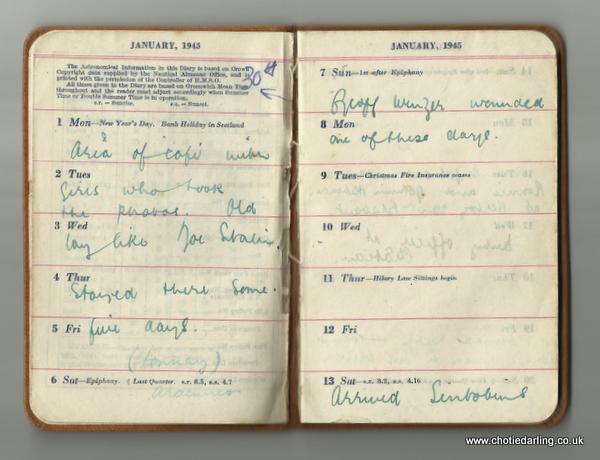
Dick's 1945 diary
Don Aiken describes the end of the Ardennes campaign:
‘It was now clear that the bold gamble had failed. The German losses had been very heavy and probably ended any possibility of Germany continuing to defy defeat. His last defensive barrier was the River Rhine, and that was going to be the next target.
Meanwhile we were returned to Iseghem, in Belgium, to continue our little rest and to be notified of our new postings.’
(Extract republished from 'From the Breakout to the Rhine' by kind permission of Don Aiken)
Eric Postles remembers the return to Iseghem:
"We got a couple of letters from our Belgian family, the last one telling us we would be returning home to Iseghem. This proved true because in the middle of January British troops were withdrawn from the Ardennes and we were told that despite everything we would still disband. The roads were atrocious as we drove independently through Mons and Ath and it was dark by the time we reached Kortrijk where we had a close encounter with a tram when we got stuck in the tramlines.
We had a very happy reunion with the family who told us they had postponed their New Year celebrations until our return. Marty and I went to church with the family and visited all the relatives for celebrations of our safe return, saving Belgium and to welcome the New Year. In the meantime we finally handed in all our vehicles and equipment. It was sad to see our carrier go. It had never let us down thanks to Jimmy Page, our driver, who was an excellent mechanic. We had a stand down parade and a regimental dance to which, after getting permission from Mum and Dad, we took the girls and Charles (Jeanne’s boyfriend, later her husband) which made their day." (Extract from ‘My War Years’ by John Eric Postles ISO used by kind permission of the author.)
Not everyone went straight back to Iseghem. Tony Rampling recalls a short spell in Brussels:
“At the end of the Ardennes the General sent a message that anybody who had been fighting in the Ardennes could go to Brussels for a short period. I think it was about 72 hours or possibly a bit more. We stayed in a bare boarded hotel…”
However, Tony remembers they were in a very lively area!
(From Anthony Rampling’s account of 61st Recce - pers comm).
Others were less fortunate. Captain Compton Bishop of ‘A’ Squadron, who had adopted the foxcub, was not seen after “we got chased down the Ardennes in January/February the following year to help the Yanks out of the Battle of the Bulge” according to Ernie Brobbin. Roy Howard mentions that the Lieutenant he went on patrol with at Briquessard was later killed in the Ardennes.
Roy reckoned that 45 men were lost from his unit during the Ardennes, including his friend Corporal Dennis Dolby who severely damaged his eyesight in a motorcycle accident.
(From ‘Beaten Paths are Safest’ by Roy Howard, Brewin Books 2004)

Recent Comments