61st Recce Regt RAC
B.L.A.
Thursday Sept 21st
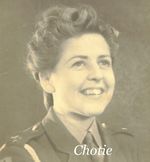
Chotie Darling,
Just a few lines (as there’s no news*) to let you know I’m OK and still fighting fit(?)
I hope your course has softened down a bit (as you should be more used to it by now) and that you’re enjoying your first visit to Scotland. I never managed to get to Edinburgh when I had my course in Scotland, though I managed to get to Glasgow.
My hand’s still shaking from testing a new armoured car we’ve received. It’s funny how driving a car fast makes the old hands so wobbly.
Heard from Diller this morning from home, where she’s on leave – including a footprint (in ink) of Michael*….Heavy nostalgia!
Very pleasant house I’m in, writing this – a well-to-do surgeon’s town-house, English Georgian style – front-door on the pavement. Some very good prints of the Flemish masters. The countryside here is very dull, being quite flat but the small towns and villages we visit from time to time are very interesting.
Managed to buy a fountain pen yesterday for 100f. (10/-) – really very cheap. I’ve saved about £100 since D-day so I must have a fling occasionally.
My mate Geoff Winzer hasn’t yet caught us up again nor Jimmy Waddell, who’s still in England. There’s only about 50% officers with us now – which makes life much duller. To compensate this however, the area we’re now in is much more interesting, more people, shops & BEER!
Ted’s crowd*** are the originators of this new push, though I haven’t yet met him. Is he still in action?
Must close here, Darling, for tea
Much love
Dicker
*Dick had to censor the letters of his men and so would have censored his own as he wrote them, leaving out anything that would indicate his unit was involved in Market Garden and possibly trying to put any interceptor off the scent.
**The Williams family dog – I think.
***Ted Lewis, married to Chotie’s sister Margaret, was in the Grenadier Guards who had charged Nijmegen bridge. By this stage of the war he’d had two tanks shot out from under him. As a Sergeant he was the vehicle commander so stood up in the tank to give directions and could leap out if the tank was ‘brewed up’. The rest of his crew in Operation Goodwood (to take Caen in Normandy) were less fortunate.
© Chotie Darling
If Dick was in Nijmegen he was certainly being deceptive – much of the northern part of the town was burned out and artillery shells were still landing in the town. It’s possible he was still in Eindhoven and his troop was still together.
Although the 101st US Airborne secured Schijndel, the town west of Veghel, they told the inhabitants not to celebrate in case they were successfully counter-attacked by the Germans. To the south even their base at Sint Oedenrode was under attack, requiring re-inforcements.
50th (Northumbria) Division, having crossed the Wilhelmina Canal on the 20th September, was back defending the column west of Eindhoven from 21st to 23rd September, although their 69th Brigade were pushed forward to the Nijmegen area on Thursday 21st.
Eric Brewer of 61st Recce ‘B’ squadron is moving up Hell’s Highway: “Moved at 4.30 in the morning to Holland. Went through to Andover (Eindhoven?) to a place called Halover. Went out on Recce but things quiet, a few vehicles knocked out here.” (From Eric Brewer’s Diary by kind permission of Derek Brewer and his family.)
52nd Recce, Dick’s future regiment, arrived in Son en Breugel on the Wilhemina Canal, coming under the command of 101st Airborne Division. They then moved up to Grave on the north-west tip of the salient.
‘Hell’s Highway’ between Eindhoven and Grave, was under constant attack from the east and the west. The Household Cavalry had discovered a large German food store at Oss (west of Grave), which was now important for supplementing disrupted supplies. Neither side could spare troops to take Oss so the store was in ‘no-man’s land’, with the British taking German rations in the morning and the Germans in the afternoon.
By dawn on 21st September the Germans had established a defence line north of Nijmegen from the village of Oosterhout (near the Waal to the west) to Ressen (north of the Allies bridgehead) and across to Bemmel, cutting off access to ‘the Island’ and Arnhem. Major Julian Cook’s paratroopers pushed forward but came up against this line.
When the Irish Guards advanced their tanks along the narrow road above the polderland their tanks were shot out ‘like ducks in a fairground booth’. 43rd (Wessex) Division, who were now defending the Guards’ left flank north of the 50th Division, was sent ahead instead and had a hard fight.
82nd US Airborne were facing strong German attacks on their positions from the Reichswald, the German forest to the east, and at night German bombers were now attempting to destroy the precious Njmegen bridge.
On Arnhem bridge, although fighting had continued through the night, the airborne troops were over-run and forced to scatter through Arnhem. Most were taken prisoner including Freddie Gough (who later escaped in 1945). German traffic was now able to cross the bridge to engage to halt the advancing column of XXX Corps heading for Elst (between Arnhem and Nijmegen).
At Oosterbeek the German infantry attacked with shells, mortars and machine-guns. Snipers, tied into tall trees, shot into the perimeter. The British still had field guns and PIATs (Projector, Infantry, Anti-tank) to see off the tanks that arrived in the afternoon but the fighting everywhere was fierce and often cruel - one group of Pathfinders (the elite group who landed first to mark out drop zones) shot a section of surrendering Germans.
The British were exhausted, short of ammunition and desperately hungry. The battle smoke meant most supplies brought in by the RAF missed their position while others were useless, containing berets, battledress, berets and blanco! The shortage of water meant medical staff could not wash their hands or the bodies of the wounded. They were also running out of bandages (begging sheets from the citizens trapped in their cellars) and morphine.
Major-General Urquhart at last managed to make radio contact with a regiment of 43rd Division in XXX Corps. By the end of the day the 1st British Airborne at Oosterbeek held only a box-shaped area of land, one and a half miles square, with the Neder Rijn river along the southern edge.
The 1st Polish Parachute Brigade, delayed for three days by bad weather, dropped at Driel, on the south bank of the Nederrijn (Lower Rhine), under heavy fire from the Germans. Their anti-tank defences had been landed north of the Rhine but on 20th September plans changed and Major General Sosabowski’s remaining forces were to drop on the south side, crossing the river by ferry to re- inforce the British at Oosterbeek. Unfortunately the ferry was destroyed by a German attack on the morning of the 21st and 46 of the 72 aircraft delivering the Poles had to turn back again because of poor weather.
Two troops of household cavalry from XXX Corps made it through the German defence line to Driel and Captain Zwolański, Urquhart’s Polish liaison officer, swam the Neder Rijn to tell Sosabowski that rafts would be sent to bring the Polish paratroopers across but they failed to appear that night.
On 21st September the second Dumbarton Oaks Conference in Washington begins to set out guidelines for the United Nations.
In Italy the Allies’ 8th Army takes Rimini on the Adriatic Coast, east of Florence, and occupies the neighbouring microstate of San Marino.
The Estonian government is forced to flee after publishing their State Gazette (Riigi Teataja) in defiance of Soviet forces.
Charles of Flanders becomes Prince-Regent of Belgium because his brother, King Leopold III, is suspected of collaboration with the Germans.
In the Pacific the US Navy attacks Manila, the capital of the Phillipines under Japanese occupation.

Recent Comments