2nd September 1944 – Canadian troops cross the border into Belgium and Canadians fighting with the British 8th Army in Italy break through the Gothic line by the coast east of San Marino.
The Germans, already moving north out of mainland Greece (to avoid being cut off by the Russian advance in the Balkans) begin to evacuate the Aegean Islands.
Soviet forces secure Bucharest, the capital of Romania, and the vital Ploesti oilfields.
The Germans cease launching V1 'buzz-bombs' from France.
Many prisoners were being taken as 61st Recce pushed forward across France, advancing from Amiens to Arras.
Eric Brewer wrote on 2nd September: “Pushed on again to a place called Farrius (Arras?). Got moved and every one in village came to see us; they sang ‘Marseillaise’ and were very pleased. Captured a good few Gerrys round here: one a Sergeant-Major and he cried his eyes out. Saw them in a corn field - a burst off the Bren soon brought them out. Passed by Pollen(?) bridge - saw all the graves of English and Canadians." (From Eric Brewer’s Diary by kind permission of Derek Brewer and his family.)
Colonel Brownrigg recorded:
“There was a pause on the Somme, then ‘C’ Squadron went over a small bridge, and continued to work their way forward on the left flank against fairly stiff opposition.
Here Lieutenant Laing’s troop of armoured cars was caught on a long, open road by a Panther, which put a round through the mudguard of his second car. They threw out their protective smoke and fired off all their weapons, none of which could damage the Panther except with a very lucky hit. This persuaded the Panther to withdraw, though it had them at its mercy; and Lieutenant Laing drove on to the village and captured forty prisoners. It was then evening, and as he had to get back to his squadron harbour he handed the prisoners over to the local French. ‘Hang on to them for me’, he said in a firm Scots accent. I’ll collect them in the morning.’ When he went for them the next day he found that the French had hanged them. ‘That’s what you told us, wasn’t it?’ they said.”
(From ‘A Reconnaissance Regiment in the B.L.A.’ by Lieutenant-Colonel P.H.A.Brownrigg D.S.O.)
Eric Postles remembers another unfortunate incident:
“On the late afternoon of 2nd September we pulled into a field to refuel etc. The troop had been picking up prisoners and all but my lead carrier had them on board.
Lieutenant Soul’s carrier suddenly blew up in a mushroom cloud and flames. We got out of the carrier but were shocked to find Lieutenant Soul badly wounded, together with the gunner (from Yorkshire). Worse still Jock Buchan, our wireless operator, and Digger Day, who transferred from the Gloucester Regiment when the regiment was formed in Ireland, were dead. All the prisoners were killed or injured by the explosion.
We never heard the outcome for Lt Soul or the gunner. We deduced that the explosion was caused by a prisoner putting too much pressure on a pannier of primed anti-tank mines causing them and petrol etc to ignite. We wrapped Jock and Digger in blankets and buried them at the end of the field beneath some trees beside a stream, marking the graves with the traditional method of a stick with their helmets on top.
As our officer would normally write to the next of kin, the Troop Sergeant asked me to do so, as I had been with them since D-day. I wrote to Jock’s mum and dad near Peterhead and Digger’s girlfriend near Cirencester. I exchanged several letters with her, in which she asked for more details and I was able to send her the photograph from Ailly which Digger was on. Unfortunately I couldn’t do the same for Jock’s family as he, like me, was not on it. Their final resting place is at the London Cemetery and Extension at Longueval, a WW1 cemetery in the Somme.” (Extract from ‘My War Years’ by John Eric Postles ISO used by kind permission of the author.)
Sandy Handley seems to have recalled the same incident:
“One day on this long journey (swan) up to Belgium, the Regiment suffered a very bad accident on the way. The Regiment were collecting prisoners – we couldn’t accommodate any as there was no space on our Humber. Mainly the Bren Carriers were able to carry 4 or 5 prisoners.
The accident occurred when we turned off the road through a gap in a hedge to harbour for a while. We parked under a tree, the Bren Carriers and Humbers continuing to come through this gap in the hedge. The prisoners were being searched for any arms and placed in a semblance of order, several of the lads were detailed to keep an eye on them, although some of the prisoners looked too tired to run away or try anything stupid. All of a sudden we heard a loud explosion and a series of smaller bangs. We immediately dived for cover in a ditch, we thought we were being mortared and attacked. We soon found out the cause of the racket as the vehicles were still coming through this gap. A Bren Gun Carrier had blown up, this had been caused by a mine. Sadly we witnessed four of the crew of this Bren Carrier along with four of the German prisoners, they had literally been blown yards away.
This was about 50 yards from our Humber now under the trees. Some of our lads had tried to drag the injured away from the exploding small arms but I don’t think any of the four crew of the Carrier survived, or the unfortunate German prisoners who were riding on it. I think of the casualties – one was a young lad who had, a few months before in April of that year (’44) walked down from the camp near Romsey with me to Southampton, that being his last walk out in England as later on the camp was sealed. As you can think this tragic accident left us all very sad and stirred up – some things one can never forget – it could have been any of us coming through that gap, which we had done just minutes before.” (From Ex Trooper S Handley’s ‘61 Recce - Memories of Normandy 1944 – 1945’, unpublished)
61st Reconnaissance Regiment took about 4,000 prisoners in their advance into Belgium. Their handling was a constant problem.
61st Recce Roll of Honour includes the following who died on this day:
Trooper John Hendry ‘Jock’ Buchan (age 20) from Inverallochy, Aberdeenshire
Trooper John ‘Digger’ Day (age 31) from Cirencester, Gloucestershire
who are laid to rest in the the London cemetery and extension, Longueval north-west of Amiens.
(See 61st Recce Roll of Honour, courtesy of Recce Mitch.)
We will remember them.
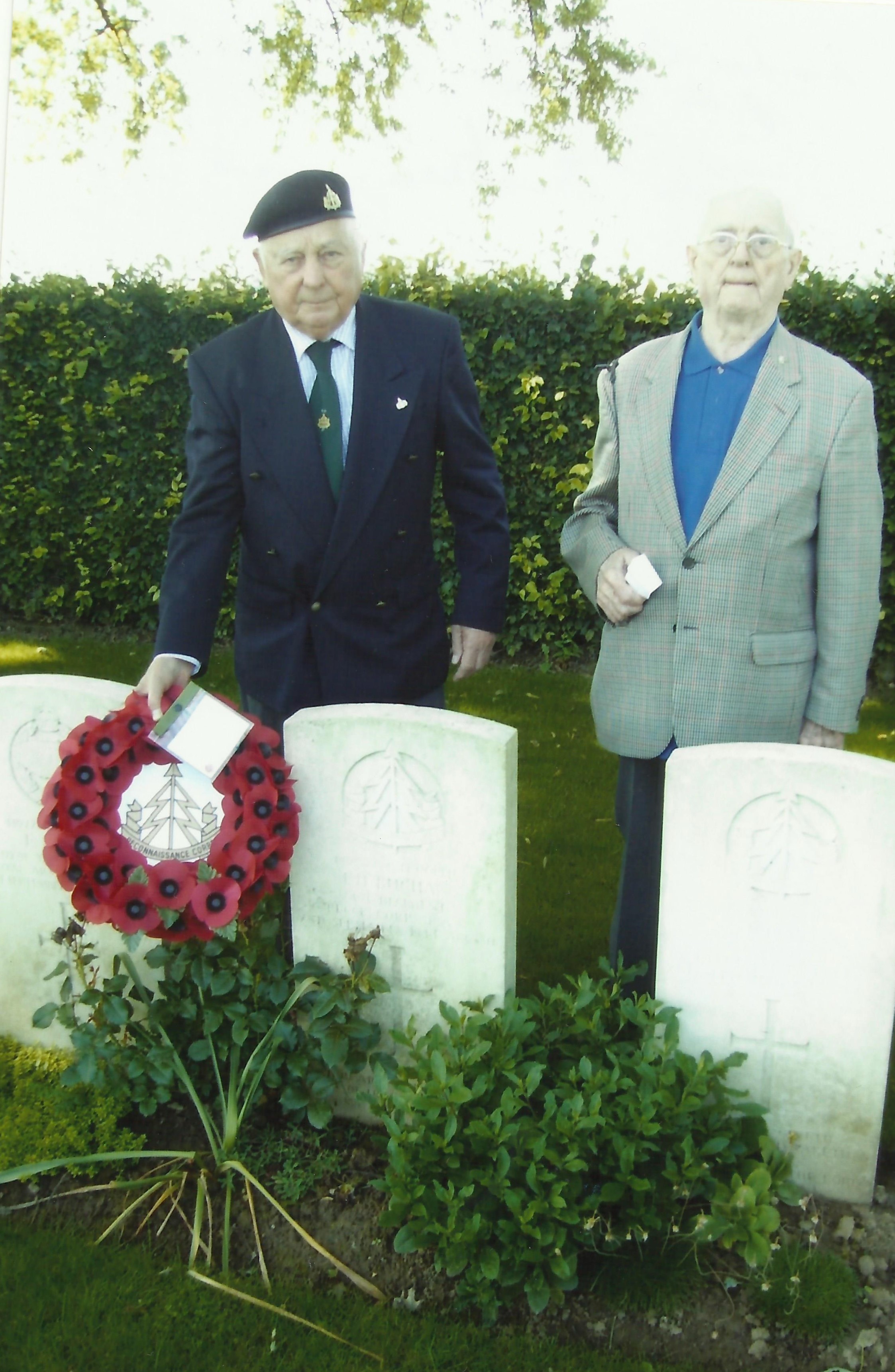 Anthony Rampling and Sandy Handley at John Buchan's grave.

Recent Comments