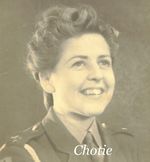
Chotie Darling
Dedicated to the memory of my mother
and all those who hold the forever young of war in their hearts.
Part 4 Only the Enemy in Front
Chapter 12 Across France and into Belgium
25th August 1944 – Paris is liberated by the Free French Forces, Leclerc's 2ème Division Blindée, and the US 4th Infantry Division and General De Gaulle enters Paris. The German Garrison Commander surrenders having disobeyed Hitler’s orders to burn the city.
De Gaulle makes a speech to unite France against the Germans at the Hôtel de Ville:
“Paris! Paris outraged! Paris broken! Paris martyred! But Paris liberated! Liberated by itself, liberated by its people with the help of the French armies, with the support and the help of all France, of the France that fights, of the only France, of the real France, of the eternal France!”
The next day the Free French parade down the Champs-Elysees led by General de Gaulle despite shots from German snipers.
Avignon is liberated by the Allies in the south of France. In Italy the Allies commence Operation Olive to crack the German’s ‘Gothic line’ across the hills and mountains north of Florence.
25th August 1944 - 43rd (Wessex) Division reached Vernon, on the west bank of the Seine,tasked with making the first assault crossing here. (The town had been liberated by French Resistance a few days earlier, the Germans retreating to the east bank at Vernonnet.) The first attempt failed when the wind changed blowing away smoke barrage created to cover the DUKWs crossing at dawn. However, a bridgehead was established on the 26th August with the support of a Folding Boat Equipment bridge using pillars from the bomb destroyed bridge and a Bailey Bridge built the next day.
*DUKWs (known as ‘Ducks’) were amphibious trucks that could be used to make a crossing or quickly assemble a bridge. They were also used in the Normandy landings.
61st Recce were beginning to assemble in the Vernon area ready for their Seine crossing.
Don Aiken recalls: “25th August - Vernon and Seine crossing
The Free French Armoured Division was ordered to advance on Paris, and we moved on to the Seine, in the vicinity of Vernon, and there we indulged in the luxury of a short bathe in the river.” ( ‘From the Breakout to the Rhine’ from the BBC People’s War website http://www.bbc.co.uk/history/ww2peopleswar/stories/35/a5791935.shtml by kind permission of Don Aiken)
Eric Brewer wrote in his diary: “Shifted to two miles off Seine. People are very nice. Went out and found Gerry barracks, which had been abandoned, also loads of vehicles knocked out round here. Think we are moving tomorrow and hope to get well across the Seine, so they say.”
A letter to his family said: “We have had a few more eggs lately and it is getting quite a habit to have at least one a day. All the lads in the section have had a bath today, one of those self-made ones, and we had plenty of water as there is a well in the farmyard near us. Also there are some good apple trees round here so we are having a good share of them.
How are you keeping? Alright I hope and also hoping that the war job is going fine. I see in the local rag that ‘For Whom the Bell Tolls’ is on at the Ritz so I expect you have seen it?” (Extracts from Eric Brewer’s diary and letters included by kind permission of Derek Brewer and his family.)
Eric Postles recalled: "Short of the River Seine 43 Division passed through us and on 25 August successfully forced a crossing of the river on the north side of Vernon and established a bridgehead. Their engineers constructed a pontoon bridge over the river (later supplemented with a stronger Bailey bridge) and troops poured over day and night. The “Swan” as we termed our advance began in earnest with orders to capture Antwerp in order to provide a supply port and try to stop the launching of V1 rockets to London and the south-east by capturing the Channel coast region from where they were being fired.
The Guards Armoured Division replaced 7th Armoured Division in 30 Corps and our division (50th) took over transport from 43 Division to enable the infantry to keep up with tanks and provide extra supplies." (Extract from ‘My War Years’ by John Eric Postles ISO used by kind permission of the author.)

Recent Comments