Ayrshire
Scotland
Friday
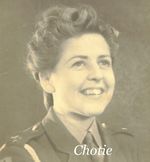
Chotie Darling,
Have just received your letter of the 19th inst. which has been forwarded up from the unit.
I was very pleased to see that Eric had replied to your letter and that I now have Eric’s address once again. No excuse now, eh?
Having a very pleasant time here doing absolutely nothing, as there seems no organisation of any sort here, and nobody worries about you.
I’m in a very cushy mess of practically every Regiment in the Army, though I’ve only met one bloke I knew before.
I took the afternoon off and walked to Irvine* some three miles along golden sands** in glorious sunshine. (I omitted to say that I had some three hours sleep in the afternoon on the beach.) I then had a beer or two in Irvine and bussed back.
Went skating on Tuesday and a dance in Ayr last night so I thought I’d have things a little quieter this evening, as I spent this morning up to my neck in the sea.***
I’ll enclose some coupons in this letter. If I remember that is. What are they worth to you?
All the pubs up here close at 8.30 pm except one in Ayr. Unfortunately the barmaid there became much too friendly for my liking so I stay clear now. She was a very charming little thing but obviously didn’t know her own mind. So now I have to drink in the mess – very unsatisfactory.
How are you behaving these days? Being a good girl I hope. Write and tell me all about him won’t you? If he’s under forty I’ll be jealous, and if he’s over forty I’ll spank you.
Must close here, Baby
All my love
Dicker
*Irvine is a town in North Ayrshire on the west coast of Scotland. A couple of Combined Operations WW2 camps were situated to the south of Irvine – HMS Dundonald trained all three services in signalling procedures to and from landing craft and the use of navigational aids to assist small landing craft find their way to designated landing places on hostile beaches. HMS Dinosaur focused on tank landing craft training. (From Combined Operations WW2 website .)
**Barassie beach
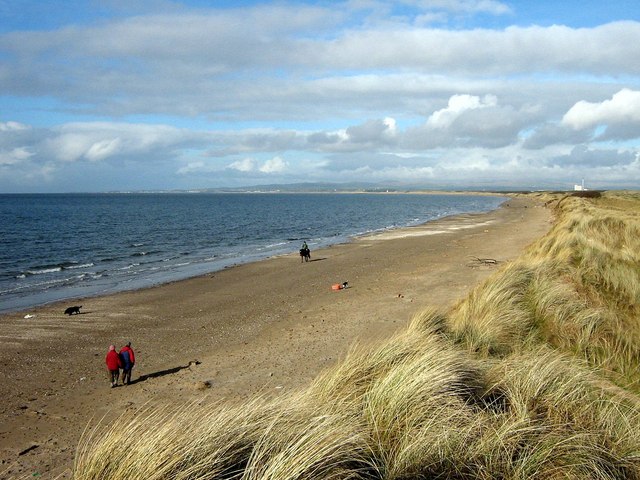
© Copyright Ian Mockford.
*** “For the landings to be successful and for breakout from the bridgehead on the French coast to be achieved the men of all three services not only had to be equipped they also had to be trained. It was to be training like no other, rigorous, realistic and relentless and much of it took place in Scotland.” (From The Scots at War Trust.)
© Chotie Darling
26th March 1944 – 10,000 German troops and French militia attack the 465 Maquisards gathered on the Plateau des Glières in Haute Savoie. The Maquis retreat and disperse although one third, unable to escape, are killed.
The 'Baby Blitz' on Bristol.
On the night of 27th March 1944 139 Luftwaffe planes flew to attack the harbour installations and fighter airfields at Bristol with high explosive bombs and phosphorous oil incendiaries. Chotie’s heavy artillery anti-aircraft battery was part of the port’s ground defences.
This was the first bombing raid on the city since 1942 and the Luftwaffe had not been able to carry out daytime photographic reconnaissance over the city since then. Poor target marking by the Germans as well as the defences of Bristol (fighter aircraft, ground defences and the successful deployment of decoy areas) contributed to the failure of the raid, despite the dropping of Düppel anti-radar foil to confuse the ATS radar operators. (This 'chaff' of small strips of aluminium foil was similar to the 'Window' technique developed by the Telecommunications Radar Establishment in Dorset. Both techniques were not used for about a year after their invention because they would be too easy for the enemy to copy.)
No bombs fell on Bristol and 13 German planes were lost – the Luftwaffe only had 287 bombers available for operations over Britain at the time. The attack was part of Operation Steinbock, bombing English cities in retaliation for the increasing number of Allied raids on German towns. (From Bristol during World War 2 and Bombing in the Bristol Area. See also Freedom from Attack.)
28th March 1944 – Russian troops advancing in the Ukraine enter Romanian territory near Nikolayev (Russian) / Mykolayiv (Ukrainian) on the Black Sea.
29th March 1944 – the advancing Japanese in India cut the Imphal-Kohima supply road and lay siege to Imphal, the state capital of Manipur, near the centre of India’s border with Burma. The siege continues until 22nd June - the Japanese withdrew from India in early July 1944. The Battles of Imphal and Kohima were the turning points of the Burma Campaign.
30th March 1944 – a RAF raid on Nuremberg with 795 bombers loses 96 aircraft, the highest loss in one night throughout the war.

Recent Comments